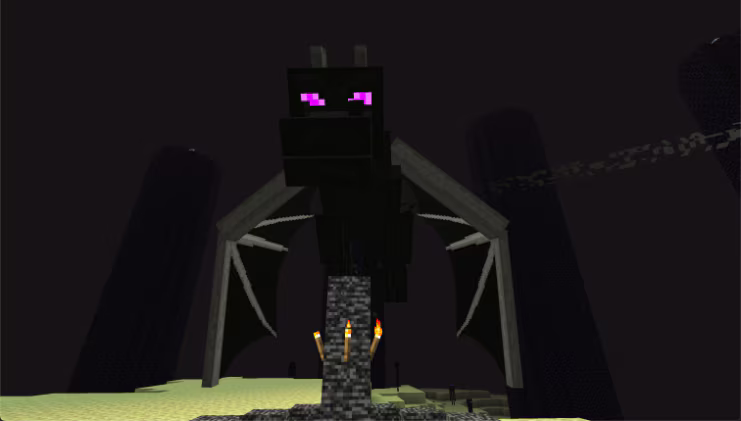
A team of four AI agents running on Google's Gemini 4 Argon model has beaten Minecraft by killing the Ender Dragon, without any human help along the way.
The run is set out in a research paper by Google DeepMind researchers Maxence Faldor, Satinder Singh and Roberta Raileanu, published on October 15th. Starting in a randomly generated survival world on Easy difficulty, the agents wrote 2,783 programs and took down the dragon in 27 hours and 14 minutes. They died 605 times on the way.
"To our knowledge, this is the first end-to-end autonomous completion of Minecraft by AI agents, achieved using only the standard Mineflayer library without pre-scouted seeds or other game-specific tools written by humans," the researchers wrote. Google DeepMind shared the result on X (formerly Twitter) on October 16th, saying the agents "divided up jobs over chat, shared notes, and debugged errors together" with no human help.
How the agents played
Each agent controlled a player through Mineflayer, an open-source library, and talked to its teammates through in-game chat and a shared memory. According to the paper, nobody gave the agents roles or wrote any game logic for them. They planned, wrote and fixed every program themselves, while researchers watched on a live dashboard and could pause or stop the run at any time. The researchers said they "had no cause to intervene".
The team built a Nether portal inside the first two hours and found a Nether fortress just before the three-hour mark. It had Eyes of Ender after 10 hours and 43 minutes and stepped into The End at 13 hours and 33 minutes. The fight there was the slow part, taking almost 14 more hours before the dragon fell.
The agents split the work between them without being told to. One built shelters for farming Endermen and landed the final blow, while others gathered supplies, sorted out tools or planned the Nether portal. According to IGN, the four swapped 229 messages in total, and a fifth agent watched over the run to check that none of them cheated. The researchers said they wanted to study how teams of AI agents work together over long tasks. The paper also argues that complex real-world software and business tasks call for the same long-running coding and teamwork, and it includes a section on the limits of the result.